

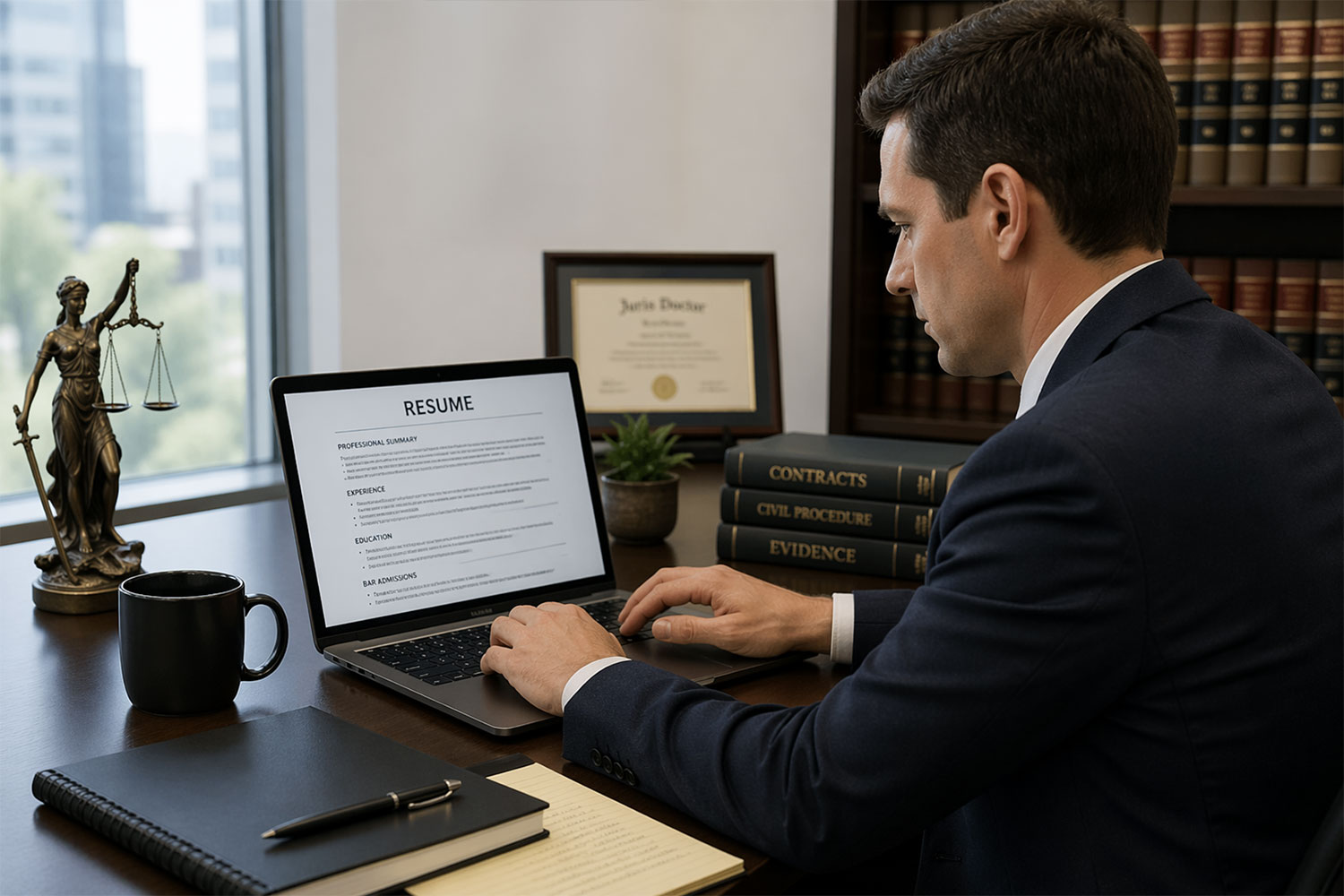
Every day, law firms receive hundreds of resumes from attorneys at every career stage. Partners and hiring managers do not have time to read them all cover to cover. That reality is not new. What surprises many candidates, however, is just how little time they have to make an impression.
A widely cited study by The Ladders found that recruiters spend an average of six seconds reviewing a resume before deciding whether to advance a candidate or move on. Six seconds is not a figure of speech. It is the window you have to communicate your value, your credentials, and your fit for the position.
That is why resume strategy matters as much as resume content. A document packed with impressive experience will still get passed over if the most important information is buried, poorly formatted, or difficult to scan. On the other hand, a well-structured resume pulls the reader in immediately and earns a deeper review that leads to an interview.
Before going further, consider this quick self-assessment: hand your resume to a colleague and ask them to review it. After about ten seconds, take it back and ask what stood out. If they cannot identify anything of substance, your resume needs work. That simple test tells you more than most editorial reviews.
The 6-Second Resume Checklist
Structuring your resume around the following six elements will maximize your impact in the critical opening seconds of any review. Each item plays a distinct role in moving a recruiter from initial scan to genuine interest.
- Name and Contact Information
- Bar Admissions, Certifications, Speaking Engagements, and Published Work
- Supporting Media and Online Presence
- Professional Title and Summary
- Core Competencies
- Highlighted Achievements
Here is what each element should accomplish.
1. Name and Contact Information
Your name should appear at the very top of the page, in a larger font size and bolded so it is immediately visible. This sounds basic, and it is. But many attorneys undermine their own first impression by burying their name in a block of text or using a font size that blends into the rest of the document.
Below your name, include your phone number, professional email address, and mailing address. One common mistake: listing an email address tied to your current employer. Set up a personal account that reflects your name cleanly, such as firstname.lastname@gmail.com. Using your firm email signals a lack of discretion and raises questions about confidentiality, neither of which is the first impression you want.
The contact block should be clean, concise, and scannable. A recruiter should be able to read your name and know exactly how to reach you within two seconds of landing on the page.
2. Bar Admissions, Certifications, Speaking Engagements, and Published Work
This section is one of the most powerful differentiators on a legal resume, and one of the most underutilized. List every relevant bar admission prominently. If you are admitted in multiple jurisdictions, that breadth signals mobility and versatility, qualities that matter deeply to firms evaluating lateral candidates.
Beyond bar admissions, include any certifications, speaking engagements, and published legal briefs or articles that reflect your area of practice. These accomplishments signal authority. They tell a recruiter not only that you practice in a given area, but that others recognize you in the field as someone worth listening to.
If your list of credentials is thin, this is the moment to be honest with yourself and take action. Seek out bar specialty certifications relevant to your practice area. Submit proposals to speak at continuing legal education programs. Write for a bar journal or legal publication. These efforts compound over time and can significantly strengthen your profile for future opportunities.
3. Supporting Media and Online Presence
Directly below your contact information, include hyperlinks to professional profiles and any publicly accessible work that demonstrates your expertise. Your LinkedIn profile is the most obvious starting point. A well-maintained LinkedIn presence functions as an extended resume and allows recruiters to verify your background and assess your professional network at a glance.
If you have been quoted in legal news, contributed to a legal blog, or if your firm features a biography page that showcases your work, link to those as well. The goal is to give the recruiter an easy path to deeper verification without requiring them to search for it independently. Make it effortless for them to find reasons to keep reading.
Keep these links current. A broken link or an outdated profile sends a subtle but damaging signal about your attention to detail.
4. Professional Title and Summary
Your professional summary is the narrative anchor of your resume. It should be no more than three to five sentences and address three essential questions: What makes you qualified for this type of role? What specific skills do you bring to the practice area? And why are you the candidate this firm should want?
Write this section with precision. Generic summaries that could apply to any attorney at any firm accomplish nothing. The summary should communicate your particular value proposition, the thing that makes you this attorney and not a generic applicant. If you specialize in complex commercial litigation with a track record in financial services disputes, say that explicitly.
Below the summary, use a targeted skills block to call out the competencies most relevant to the position you are pursuing. This supplements the narrative summary with a scannable reference that recruiters can absorb instantly.
5. Core Competencies
Core competencies serve as the keyword infrastructure of your resume. Many law firms now use applicant tracking systems to pre-screen resumes before a human ever looks at them. A resume that does not include the right terminology for a given practice area may be filtered out automatically.
Research the language your target firms use to describe the work you do. Review job postings, firm websites, and practice group descriptions. Then make sure the same language appears in your competencies section. This is not about fabricating expertise. It is about ensuring that your genuine qualifications are described in terms that register with both automated systems and human reviewers.
Keep this section tight and relevant. A list of twenty-five competencies across five practice areas tells the reader nothing useful. A focused list of eight to ten competencies closely aligned with your specialty communicates clarity and intent.
6. Highlighted Achievements
Credentials establish that you are qualified. Achievements demonstrate that you deliver results. These are different things, and both matter.
Highlight the cases you have won, the deals you have closed, the settlements you have negotiated, and the clients you have retained and grown. Be specific wherever professional responsibility rules allow. Vague references to successful outcomes are far less compelling than concrete examples of what you accomplished and at what scale.
Focus your highlighted achievements on work that is directly relevant to the position you are pursuing. A lateral partner candidate seeking a role at a firm with a strong M&A practice should lead with transaction experience and deal values, not general litigation wins. Relevance is the filter. Everything on your resume should answer the implicit question every recruiter is asking: Why is this person right for this particular role?
Final Formatting Considerations
Content is the priority, but formatting determines whether that content gets read. A few critical adjustments can significantly improve the readability of your resume.
First, omit any reference to your birthdate, marital status, or religion. This information has no bearing on your qualifications and creates unnecessary risk for both parties in the review process.
Second, increase your line spacing to at least 120 percent of your font size. Dense, compressed text is difficult to scan quickly and signals a lack of editorial judgment. White space is not wasted space. It is what makes the important information visible.
Third, use divider lines between sections. Clean visual breaks guide the reader’s eye through the document and reinforce the logical structure of your presentation. A recruiter moving through your resume in six seconds should be able to land on any section and immediately understand what they are looking at.
Taken together, these adjustments serve a single purpose: making your resume tell a clear, compelling story about why you are the right attorney for this firm. The goal is not to impress with volume. It is to demonstrate, within seconds, that you understand what the firm needs and that you are uniquely positioned to deliver it.
About On Balance Search Consultants
On Balance offers great insight and industry intelligence. Shari Davidson, president of On Balance Search Consultants, advises law firms on how to take a firm to the next level and helps rising talent make the transition to the right law firm.
Contact us today. Call 516.731.3400 or visit our website at https://www.onbalancesearch.com.
Please note that the content of this blog does not constitute legal advice and is only intended for the educational purpose of the reader. Please consult your legal counsel for specifics regarding your unique circumstances and the laws in your states pertaining to social media and any legal restrictions regarding the law.